
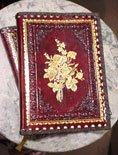
Blindingham Hall September 27 1863
Villiers has spent the afternoon understairs at the Cornbenches and returned with flour, sugar and gossip in equal quantities. I had sent him over to them after a disastrous market trip during which his purse was lost, forcing him to come home empty handed. Apparently there are some folk who have arrived in the village bent on trickery – one distracts a poor innocent about to purchase goods whilst another silently reaches into a bag or pocket to steal the contents and pass them to yet another, at some distance. Villiers told me that a man had engaged him in conversation of such fascination that he had no notion that another man was reaching behind him. ‘Please look upon my mortification, Ma’am, and know that I shall repay every penny that was taken, if it takes me the rest of my days.’
I decided that making him spend time with the Cornbench household staff would be a greater punishment, and anyway we needed the goods that he had been so cruelly prevented from buying himself. His return showed no sign of remorse or punishment – quite the opposite. He danced up to my desk with a soft cloth, pretended to polish the hinges and shine the inkwell, and ventured comments in the hope I would ask him what had happened there.
‘Ma’am – I have news.’
‘So does the newspaper, Villiers, I prefer to gather my information from that source, since those who fill its pages are likely to give a truthful and balanced account of events’
‘Ma’am – the newspaper knows nothing of the neighbouring households and what goes on in them’
‘Is that because household management is not typically regarded as news?’
‘If it isn’t, Ma’am, it should be’
He started to pay faux attention to the mantelpiece, moving a candlestick and staring at the side of the mirror looking for dust. I capitulated and asked what news he felt should be broadcast.
‘Well – Mrs Cornbench has engaged a new Estate Manager, after what happened with the last one. We shan’t know the outcome of that until the Weddlebridge Assizes have sat. The new one told his mistress that he would only take the position if he could bring with him some staff from his previous job.’
‘Villiers, I know all this. I was apprised of it a few evenings ago when that horrible new Housekeeper set their dog on me.’
‘Pardon, Ma’am – but you only know what she chose to tell you. The truth is that Mrs Cornbench has allowed the new Estate Manager free licence to employ whomever he chooses. So after only two months, the whole of the Upstairs staff from Lady Temple’s estate have taken up new roles. Most of the former servants have been sent packing! It’s an outrage!’
‘Lady Temple? The widow who lives in Temple Meadow Hall?’
‘The very same, Ma’am. It seems that the poor woman is now wandering around empty rooms with only the older servants left. The Estate Manager, the House-Keeper, the parlour-maid and the Butler are all now working in Cornbench House!’
‘And how do the Cornbench faithful servants feel now that their upstairs staff have been usurped?’
‘Unhappy to say the least, Ma’am. Cook blames a new strain of onion for her constant tears, and Barker has taken to drink – he says he is just waiting to be dismissed, he plans to live with his daughter, if he is given a suitable amount to live on. The Boy is going to ask around in the village for other openings – he is a good worker and would be snapped up by another family before you can say footstool. It is an outrage. Experienced servants are being cast aside to allow upstarts to walk the floors. It shouldn’t be allowed!’
I had to admit that his anger was a boon to the woodwork, his pretence of dusting had turned to vigorous activity, my mantel was a glory to behold. But I could not let his words go unchallenged, he was in danger of over-reaching his position.
‘Villiers, I am concerned that you and the Cornbench understaff may be speaking out of turn – you do not have the pleasure and burden of owning and managing an estate, you do not know what such a responsibility entails.’
Villiers gave a small laugh, and a loud smack of the cloth as he applied it to the window frame.
‘I am quite serious. You do not have the full picture of what needs to be done to keep the household and land running safely and profitably. It is the sort of pressure that can keep one from sleep.’
‘Perhaps not, Ma’am. Indeed we may not know what should be done. But we do see what actually happens.’

 Effie in Blindingham