Incursion

Blindingham Hall September 27 1863

Villiers has spent the afternoon understairs at the Cornbenches and returned with flour, sugar and gossip in equal quantities. I had sent him over to them after a disastrous market trip during which his purse was lost, forcing him to come home empty handed. Apparently there are some folk who have arrived in the village bent on trickery – one distracts a poor innocent about to purchase goods whilst another silently reaches into a bag or pocket to steal the contents and pass them to yet another, at some distance. Villiers told me that a man had engaged him in conversation of such fascination that he had no notion that another man was reaching behind him. ‘Please look upon my mortification, Ma’am, and know that I shall repay every penny that was taken, if it takes me the rest of my days.’

I decided that making him spend time with the Cornbench household staff would be a greater punishment, and anyway we needed the goods that he had been so cruelly prevented from buying himself. His return showed no sign of remorse or punishment – quite the opposite. He danced up to my desk with a soft cloth, pretended to polish the hinges and shine the inkwell, and ventured comments in the hope I would ask him what had happened there.

‘Ma’am – I have news.’

‘So does the newspaper, Villiers, I prefer to gather my information from that source, since those who fill its pages are likely to give a truthful and balanced account of events’

‘Ma’am – the newspaper knows nothing of the neighbouring households and what goes on in them’

‘Is that because household management is not typically regarded as news?’

‘If it isn’t, Ma’am, it should be’

He started to pay faux attention to the mantelpiece, moving a candlestick and staring at the side of the mirror looking for dust. I capitulated and asked what news he felt should be broadcast.

‘Well – Mrs Cornbench has engaged a new Estate Manager, after what happened with the last one. We shan’t know the outcome of that until the Weddlebridge Assizes have sat. The new one told his mistress that he would only take the position if he could bring with him some staff from his previous job.’

‘Villiers, I know all this. I was apprised of it a few evenings ago when that horrible new Housekeeper set their dog on me.’

‘Pardon, Ma’am – but you only know what she chose to tell you. The truth is that Mrs Cornbench has allowed the new Estate Manager free licence to employ whomever he chooses. So after only two months, the whole of the Upstairs staff from Lady Temple’s estate have taken up new roles. Most of the former servants have been sent packing! It’s an outrage!’

‘Lady Temple? The widow who lives in Temple Meadow Hall?’

‘The very same, Ma’am. It seems that the poor woman is now wandering around empty rooms with only the older servants left. The Estate Manager, the House-Keeper, the parlour-maid and the Butler are all now working in Cornbench House!’

‘And how do the Cornbench faithful servants feel now that their upstairs staff have been usurped?’

‘Unhappy to say the least, Ma’am. Cook blames a new strain of onion for her constant tears, and Barker has taken to drink – he says he is just waiting to be dismissed, he plans to live with his daughter, if he is given a suitable amount to live on. The Boy is going to ask around in the village for other openings – he is a good worker and would be snapped up by another family before you can say footstool. It is an outrage. Experienced servants are being cast aside to allow upstarts to walk the floors. It shouldn’t be allowed!’

I had to admit that his anger was a boon to the woodwork, his pretence of dusting had turned to vigorous activity, my mantel was a glory to behold. But I could not let his words go unchallenged, he was in danger of over-reaching his position.

‘Villiers, I am concerned that you and the Cornbench understaff may be speaking out of turn – you do not have the pleasure and burden of owning and managing an estate, you do not know what such a responsibility entails.’

Villiers gave a small laugh, and a loud smack of the cloth as he applied it to the window frame.

‘I am quite serious. You do not have the full picture of what needs to be done to keep the household and land running safely and profitably. It is the sort of pressure that can keep one from sleep.’

‘Perhaps not, Ma’am. Indeed we may not know what should be done. But we do see what actually happens.’

Cold, Cold Heart

Blindingham Hall September 1863

I have met a monster. A small, young, pretty thing in truth, but a monster nonetheless.

I had received an invitation to dine with the Cornbenches. This is a disturbingly regular act of neighbourly disposition on their part, and one which I choose never to reciprocate. Villiers knows better than to suggest I might sit at my own table with them – Lord forbid. I asked Villiers which reason I had given for declining the invitation the last time, and the time before. Alas, I had to conclude that illness and family bereavement was not a suitable excuse again so soon. The Cornbenches would be sending doctors to my door, and those of my non-existent distant relatives, fearing some terrible hereditary disease for them to wring their thin hands over.

So, at 7pm yesterday evening, I presented myself at their door. Waiting for me was their rib-shivering dog, Romulus, and a shiny new house-keeper. I had expected the former, but the latter was the most unpleasant shock, I can not lie. The dog whined and wagged its tail as I entered the atrium, causing me to take a step back. It moved towards me, I dropped my gloves before I could place them on the salver and I uttered a plea for it to approach no further.

The House-keeper smiled – not in welcome I swear, but to see my distress. And then she spoke to me in the most condescending of tones.

‘Oh, has the dog upset you? I was not told that Romulus was unacceptable to you. He is the mildest of creatures but I see that My Lady is fearful of him. Had I known that, I would have made sure he was kept in the kitchen’ she said. ‘I am new in this posting and Mrs Cornbench thinks highly of me, I know. But if those who have worked here for some time do not do their jobs properly, how am I supposed to do mine?’

She pulled the hall bell rope as if she was sending a gallowed man to his death, then shouted ‘Cora! Cora – come here immediately and take the dog downstairs! You should have told me Lady Hatherwick is one of those people who dislikes dogs!’ Poor Cora shot out from the understairs door and swept the dog away, whispering her apology and berating it for breathing.

‘I don’t think I have met you before, you say you are new?’ I asked ‘I am indeed’ she said, ‘ I was brought into Mrs Cornbench’s employ but three weeks ago. My name is Judith. I was recommended for this position by a previous employer, one who I understand is also about to take up a post here, as estate manager. Would My Lady like to wait in the Library? Madam will be down forthwith.’ She motioned towards a chair by the window and whisked herself out of the room.

As I waited – surrounded by unread books behind unopened glass doors – I considered my first impression of Judith. She had shiny brown hair and smooth skin, with a small waist and a soft voice. To write her characteristics down one would be forgiven for thinking I was embarking on a romantic novel with a sweet heroine. Not so. This Judith had steely eyes, hard fingers and lips which could never curl upwards. Within seconds of meeting her I knew I had seen the worst of us.

If I could have seen Judith’s heart I am sure it would be small, dessicated and as cold as the consomme she served me at dinner.

I feared for Mrs Cornbench’s judgement, and even more for her welfare. I will wish illness and death on myself and everyone I know, if it spares me from another evening under Judith’s gaze.

Welsh Exit

Blindingham Hall August 1863

When I was married to Josiah, I experienced an evening with him so dreadful that I can not bear to record it, even after all these years. I will spare you, and myself, the remembrance of it – save to say that I wished I could have been anywhere else than where I was. I willed myself to bear it because I had no choice but to stay, but in my head I escaped and fled to the safety of my own thoughts. I prayed never to experience the like again, and would not wish it on the most loathsome of enemies. Even now I shudder that I survived.

I was reminded of that evening last Wednesday, watching LOVE IN A VILLAGE, seated next to the odious Mr Sloakham.

The play itself was incomprehensible. It took place in a fictional setting, indicated by pieces of wood painted to look like bushes and a church steeple made from a linen box, balanced on top of a table. A woman was in search of a husband, but suitable men were not in evidence. A man wanted a wife but was not capable of even the most simple courteous conversation. Yet another man was trying to arrange a meeting between them. He was thwarted by circumstance on more than one occasion, and at one point the woman sang. I cared little for either of them, and even less for the singing. Some other people came in and out – dressed in sacking, some of them, others in fancy hats – to perform various tasks and declaim wisely on the subject of love, marriage and the vagaries of social interaction. In truth, I am no wiser now on that point than I was at 7pm last Wednesday, but at least since then I have not had to sit through someone else trying to explain it to me.

All the way through the performance, Mr Sloakham’s teeth raced around his head with such force that I fancied an army was approaching over gravel. The singing and the rattling became too much for me so that by the time the uncouth man finally made love to the desperate woman I was holding my hands over my ears and thinking only of Dauncey, waiting for me at the Hall.

The play ended with a dismal wedding, but I was glad to see it all the same – I would be able to leave within moments. But as the clapping of my fellow villagers waned, one of the troupe stood forward and addressed us:

‘Thank you so much for coming to our play. We are especially pleased this evening to have Mrs Edith Feltwhistle, our esteemed playwright among us. She will be happy to take questions from you, alongside members of the company. Please remain seated, we shall return – out of costume – presently’

My fellow audience members chattered happily and moved forward in their seats. ‘I must enquire how they know what to say and when to say it’, said one. ‘Indeed,’ said her friend, ‘And I wish to know what they do during the day’

I caught Villiers’ eye as he shuffled into the Hall, his blanket nowhere to be seen. He clearly wanted to know the answers to those questions – and probably some of his own – and stood open-mouthed looking at the door from which the actors were going to return.

I motioned to him. ‘Ask Moss to bring the carriage round, now’

As the actors returned to the church room stage, to a warm welcome from the crowd and a fanfare of applause from Mr Sloakham, I gave Moss the sign to get us home.

Not for the first time, I was grateful for Moss’ eagerness and skill as a driver.

Preview Night

Blindingham Hall, August 1863

Lord save me from theatrical troupes! How tiresome and self-regarding they are, it’s exhausting. A Travelling gaggle has arrived in the village from somewhere godforsaken, on their way to London. They must not yet be proficient in their art because they need us to watch it for them before they decide whether it is good enough for the theatregoers of the capital. Apparently they want to hear what the good folk of Blindingham – and every other village between here and the Haymarket – think of their tedious tale-telling. Quite frankly I would sooner place my toes in a vice, but as Lady of the Hall I have been invited to patronise the event, so I shall have to go. I hope they put a cushion on my seat.

I was quite unaware of our bounty at such cultural diversion until Villiers told me that a little man had been accosting innocent people going about their business at the market, entreating them to stop their work, ignore their duties and present themselves in the church rooms at 7pm on Wednesday. As if we have nothing better to do. The little man wore a banded hat so his baldness wouldn’t scare people as he approached. Villiers apparently told the man who his mistress is, and was thereupon beseeched to ensure my attendance. He was so enthralled by this man, a rattle-teeth by the name of Sloakham whose whispering tone and slight air of menace had earned him the role of chief persuader, that Villiers forgot his market errands and rushed back to the Hall.

‘Ma’am! Actors are in the village, actors! Look!’ he panted, ‘They are putting on a play – how lucky we are, will you go, Ma’am. Might I accompany you in the carriage and wait for you? Shall I go right away to where the actors are preparing and tell them you will attend their performance?’

He handed me a crumpled piece of paper, much smoothed but barely legible, with the name of the play in large letters – LOVE IN A VILLAGE by Mrs Edith Feltwhistle, and some names underneath, none of which meant anything to me. Apparently I would laugh, cry and understand the human condition, all in the space of 100 minutes. I did not think this would be the case but I could see how much Villiers wished it to be true.

I forgave him for not bringing back any eggs or bread, and allowed myself to indulge his palpable excitement.

‘Very well, Villiers. We shall go. Tell Moss to have the carriage ready for 6 o’clock on the night, and pack yourself a blanket. You can not sit with me of course, but I dare say there will be room outside for you to watch through the door’ Villiers squealed his thanks and swept off to find the little man and his actors.

I am dreading the evening already. Such shouting, men with painted faces and women who should be at home, such drama. And then the play itself. What possesses people to dress up and prance about pretending to be other people?

Thursday can not come quickly enough for me.

Carnivorous Beasties

Blindingham Hall September 30 1862

Oh, how tiresome it is to be in great demand for village events!

For a number of years when I was growing up, Papa would preside over the annual meat fair – a celebration of butchery and farming which excited those in the village who needed to preserve supplies for the winter months. Those whose seasonal picking incomes would not allow for regular visits to the market, but who would happily wrap offcuts in salted muslin and eke them out as watery soup til the Spring. You may remember the Christmas goose whose submerged carcass was unfit for my table? That was the work of an undercook whose mother had been a picker, poor woman. I had to dismiss the girl, she was never going to outgrow such impoverished culinary roots.

When Papa left for London, the role of Master of the Meat Fair fell to Josiah – who relished the opportunity to stand on a crate in the square and bestow his judgement on the shanks and shoulders paraded before him. I was not present at these gatherings, but admit to being the beneficiary of a little local butcher-bribery. The prize was notoriety for miles around, guaranteeing a steady flow of customers throughout the year, and the cuts that did not impress were distributed amongst the villagers, who then bartered for what was left. I found the whole process a little unseemly, in truth.

Late last month I was approached to stand as Mistress of the Meat Fair partly because I am the owner of the Hall but principally because there is no-one else in this parish who does not genuinely need the produce on show. So my civic duty over-rode my distaste for once and yesterday I stood atop a milking stool and smiled as if I were at the circus.

Placed at my feet was a succession of slaughtered animals, some rent asunder by the sharpest of butcher’s knives, others presented shorn or plucked but whole – all laid out for my inspection. Chickens, rabbits, sheep, cows and pigs – many still warm from being caught – lay waiting for my verdict. I hardly knew where to start.

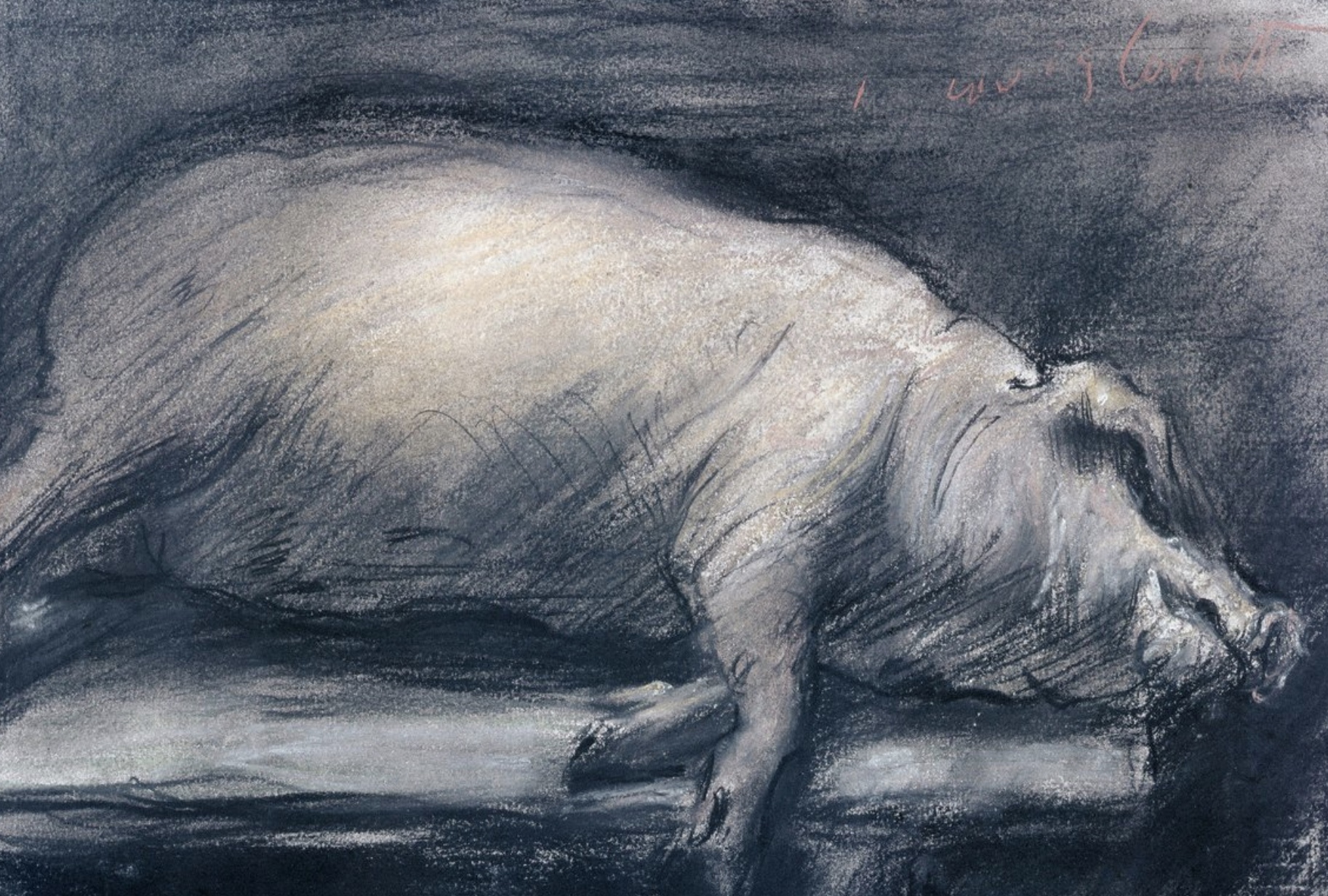
The most prominent offering was a large, uncut pig. His skin was pale pink and slightly moist and the small, dark currant eyes were still in his head. He was swollen with whatever the farmer had fed him for the purposes of showing him off, sparse hairs poked from his chin, and I felt that at the slightest touch his skin would split open to let the fat ooze forth.

Farmers, Butchers and expectant villagers crowded my stool, waiting for me to award the First and Second Prize, which would herald the the commencement of trading for the losing beasts. The pig lay there, facing the crowd but wholly reliant on my word. Its fate was in one sense already decided – slaughtered at its youthful, juiciest point – but in another sense entirely in my hands.

So I made my decisions and placed the rosettes. I pointed downwards to a pig whose head and legs had already been removed and cried:

‘To the farmer of this creature, and the butcher of its body I present the Half-Ham award’ There was much cheering and patting on backs and joshing amongst those responsible for the dismembered runner up. The farmer snatched it up, dancing with joy and swearing to be back next year with the winner. Silence fell again and I gestured towards the shiny, bloated pig I had chosen.

‘This year, people of Blindingham, it gives me great pleasure to give this fine example of force-fed succulence, at the peak of its porcinity, the pinnacle of it’s pig bred perfection… ‘ (I began to see why Josiah had enjoyed this role so much) the top prize today. I give this creature the Full Ham award!’

I stepped down from my stool, helped by the jubilant breeder whose income I had just secured for the next year. I did not stay to watch the scraps being fought over, and tried to note the shoulder brands so that if any of it turned up in the kitchens at the Hall I could make sure it was fed to the dogs.

I may be asked again next year, and if yesterday’s experience is to be trusted as a guide I may well accept.

Nominative Determinism

Blindingham Hall, May 30th 1862

Villiers has excelled himself.

He skittered up to me last Sunday, while I was on the terrace taking tea after church. He was so excited, full of noise and flutter, I could be forgiven for thinking there were three of him.

‘Ma’am, ma’am! I have been told of the most wonderful opportunity to adorn the approach whilst warding off unwelcome visitors.’ He squealed. ‘Not only will this make the gardens so much more divine, your reputation for good taste will reach far and wide. Your eye for natural beauty, wonderful as it already is, will be the talk of the County! If I can be spared to make a trip over to Weddlebridge market tomorrow, Ma’am, I should return with the finest specimen for miles around.’

‘Villiers, calm yourself – what on earth is it that has you in such a turnover?’ I asked him. Before he could answer he danced a tiny jig on the steps and swung down from the balustrade. ‘Oh, Ma’am…I think this is one of my best ideas yet!’

My tea had become cold. Whilst I sent for more hot water, Villiers explained to me in fulsome detail what was to happen. For it was indeed a decision already made. I could no more prevent it than I could sew buttons on the sun.

Thus now, much to my delight, we have a peacock on the lawn!

He is a young one, with no fear of approaching vehicles nor knowledge of what will poison him so for now we have him penned outside the lodge. His markings are a sight to behold. The bright flashes of azure and emerald when he chooses to display his tail remind me of a silk dressing gown I once owned. It was a favourite of mine and much admired by Villiers. I don’t know where it went.

This bird makes the most terrifying noise, and I am given to understand that as he grows in stature and confidence he will become louder and more frightening. My first and most fervent hope is that this will make the Cornbenches think twice before wandering across the field with whatever craft or preserve they have just produced. It will be worth the price of the feed just for that.

Just imagine. My very own peacock! I am beyond happy with Villiers for this suggestion and have resolved to allow more to be brought, since I believe it will need company and constant reminding of its beauty.

Yesterday’s Man

Blindingham Hall May 20th 1862

The welshwoman at the post office has been usurped!

For a number of years I have relied on her communication skills to find out, and pass on to others, the news that matters. Not in the World, of course, where most of us have no knowledge of decisions men make or the power to change them, but here in the village where life and death concerns are raw and faced daily. She uses the language of the valleys to convey information. She asks a question, to which the answer is already implicit, and has a remarkable way of making everyone she speaks to feel as though they are the only trusted recipient of her words. She makes me wish, for a moment at least, that I were Welsh myself.

But she has a rival, newly arrived and quite determined to become the messenger. He has come from London, where he was employed by a newspaper. His views were apparently widely sought, for a time. They tell me he would write long treatises on foreign affairs and have them printed in the finest of publications – the kind Josiah would stare at over breakfast and then smite the page with his hand as if he could have said as much himself if anyone cared to listen. The printing press run by Mrs Doughty would never produce such esteemed literature, but even I understand how important words appear when someone has taken the trouble to put them in a block and ink them.

This man introduces himself to us simple village folk as a ‘journalist’. I gather from what little French I studied that by using this title he believes his opinions assume daily import, but they are no longer presented on paper for all to see. Rather, he sits in the Inn and addresses which ever poor soul arrives for refreshment and a little company. I am sure he also addresses those who wish to be left alone, but I do not frequent the Inn myself so I can only imagine what being in his presence is like. As baby birds sit open-mouthed in the nest waiting for sustenance, the drinkers must turn to him. How vital he must feel, momentarily.

His name is Flinch, it appears. How apposite.

From what I am told by Villiers, who does attend certain gatherings there on his rest days, Mr Flinch has quite the bit between his teeth. His target is the men in London whose activity he used to note, and who still appear to operate without his observations. How pointless they must have been! He claims that he has knowledge the rest of us would be glad to hear, but he does not ever state what that knowledge is. Villiers says the man employs ‘tantalism’. Which I must interpret as meaning that the ‘news’ will be forever implied and never imparted.

I feel however, that the usual tasks and botherings of the people of Blindingham do not include how their superiors fill time not filled with actual work. I have resolved to avoid this man, should he ever attempt to approach me. Instead I shall rely on Welsh intelligence, such as it is.

Supplicant

Blindingham Hall April 5 1862

Lord in his mercy – when will the local folk come to accept that their lives are of little interest to me!

This afternoon I took tea in my parlour with the Reverend Dibleigh, a man whose capacity for conversation is boundless and whose high opinion of himself is sorely misplaced. Villiers showed him in, with an announcement and flourish rarely seen outside of a Playhouse:

‘Ma’am!’ He shouted, as he entered the room with the vicar swept up in his wake. ‘I have great pleasure in showing his Reverence to your private quarters. How lucky we are that he has time to call! ‘

Villiers’ excitement was further indicated by a series of tiny skips between the door and my chaise, where he directed with a broad spread of his arms that the vicar was to sit. I was given to understand that he wished to speak to me about his accommodation, which he seems to feel is in need of some refurbishment. I am at a loss to know what he expects me to do about his window catches or his roof, but I have had few visitors thus far this year and wanted to be entertained.

I offered him tea, of course, and small cakes – I had requested unbuttered buns for this visit, because I believe a man of higher calling should not be indulged with sugar and fat. Indeed I worry that his powers of celestial reception can be hindered by the pastries he is plied with by parishioners. His power should simply be fuelled with a salted oat slice, I feel, but I wanted some cake myself. I pray I will be forgiven for noting that the body of Christ is of course fulfilling, but hardly in a corporeal sense.

The Reverend spoke with much animation and little pause. Crumbs from his second bun fell onto his collar as he became more exercised. I was reminded of the salmon flake he retrieved from his lip during his last domestic visit and was glad I had not asked Cook for the jam.

‘How gratified I am for your attention, my Lady’ he beamed ‘I hold your opinion in the highest regard, as I hope you know. Your consideration of my circumstances is an honour.’

I care nothing for thatch or slate, and if the vicar is colder in the mornings than he likes to be I think he should consider the privations of our Lord rather than ask for his casements to be refitted. But I am flattered by his insistence that I am a woman of taste. He is right in that regard. Whilst I find his interest in cushions a trifle strange, I do love a chance to discuss my eye for elegance.

After more than forty minutes of listening to him I was exhausted – his florid mannerisms should keep him warm, even if his windows won’t – so in order to bring an end to the visit, I told him I would send my building manager to the vicarage to see what could be done.

‘Goodness me, Lady Hatherwick, what a welcome but surprising offer! I shall of course accept and will look forward to whatever your estate staff suggest. I can hardly believe that I am to be the recipient of such generosity!’

Some more chatter took place and then, mercifully, he left.

Staff and plans cost nothing, so I am content to fulfil my promise. Funds for materials and labour he must source from another parishioner, perhaps from one who also provides the services of a pastry cook.

Each Peach

Blindingham Hall, April 1862

Word has reached me that Josiah’s political aspirations have taken a turn for the better. Better for him, of course, not for the poor souls whose interests and wellbeing he purports to represent.

In truth I have not spoken, thought, nor even dreamt of Josiah for many months. I knew he had taken up with weasel schemers to gain high office but I had no notion his activity might affect me or anyone I care about. I was simply in conversation with the Welshwoman yesterday, standing at a fruit cart choosing peaches, when the subject of him arose.

‘Lady Hatherwick I must say that your husband is making a name for himself up in town. He’s becoming quite the man to follow. His ideas for increasing wealth amongst the businessmen in the capital are inspirational’

‘I beg your pardon?’

‘I was in London to be given instruction on how to apply the new postal rates for Canada, not that I think anyone in the village needs to write to anyone there. I heard your husband’s name spoken of more than once in the corridors of finance there. He intends to work for Mr Gladstone, I believe. He is very highly regarded.’

Corridors of finance, my Aunt Margaret.

She looked so proud to have been in London for a more serious reason than to acquire a roll or two of the latest dress fabric. I felt the devil take hold of me.

‘My husband?’ I said, feigning alarm, ‘I have no husband! Who is making such a claim ? Do they intend a charge on my estate perhaps? Does this man wish to take over the Hall? I must speak with my lawyer at once. I am , and have been for years, happily husband-free. If there is a man pretending to the current role of Master of Blindingham, he must be stopped! ‘

‘Well…no…I meant…I’m sorry…I was simply….I only meant…..’

‘You meant to share news of Josiah, I am sure. News which I do not want to hear. News which is only news in the mouth of the person telling the tale. Please do not say any more to me of his actions or whereabouts.’

‘I hope I have not offended you with my careless misremembrance, Lady Hatherwick. I have no wish to cause you alarm’ She simpered at me, but seemed pleased to have caught my attention for longer than she can normally manage. Perhaps I would care more for her musings if she were not Welsh, but as it is she bores me.

‘I am as alarmed as I am interested, which is not at all.’ I said, as I selected three peaches to present to the barrow boy for payment. ‘Josiah could change the face of commerce and I would not profit; he could find a cure for the palsy and I would not allow myself to be treated; he could be crowned King of all the Realm and I would repudiate his reign.’

She moved to one side as I handed my coins to the boy. A cart of lemons had caught my attention, so I had reason to get away and she did not attempt to follow.

Such talk of Josiah and his successes has quite put me about.

Now, I am sitting at my desk with three peaches in a wooden bowl. I may eat one this afternoon and have the others for breakfast. Then again, I may let them rot.

Parochial Proximity

Blindingham Hall, January 1862

Such is the curse of mingling in winter! I attended a gathering in the village hall to celebrate some festival or another – I don’t recall which, beyond thinking that the hedgerow-gathered decorations were gaudy. I spoke to as many of the local folk as I could, which is a duty that as Lady of Blindingham Hall I feel is impossible to shirk. I have paid a terrible price, however, as it seems that one in every ten of them was awash with infection.

My sense of civic charity – which compels me to spend time with those whose lives my patronage supports – has been my downfall, I fear. I have coughed like a horse for days. My fever is high and my chest feels as though the devil himself is bestride me. I have been confined to bed for too long, and scarcely know whether it is day, night or next Tuesday.

Villiers creeps into my room every so often with a tincture or a dollop of bread sauce. He tries to be attentive, I can see he wants to do his job, but he is clearly petrified of contracting whatever it is that has laid me so low. I am lonely enough up here already, without being treated as a pariah. I must speak to him when I am well again, and make him understand that to be my servant he must actually serve me, not avoid me.

I shall attempt to dress in the morning – assuming my maid is not as scared to be near me as Villiers is – and may even try to take tea on the terrace. The weather is bright, but I can see frost across the chapel roof. Papa always used to say that fresh air was the best Physic. He often refused whatever the doctor offered, and not for want of being able to pay for it, oh no. He simply believed that nature was its own medicine.

How I miss him.