Golden

05d36-journal_sm

June 27th 1860, Blindingham Hall

I pace these rooms like a trapped cat.

I sent word to Boo that if she did indeed have any thoughts on what I might set before a Judge I should be pleased to hear them. I must, must be a free woman by the Autumn, I can bear it no longer!

I have not explained myself fully yet – nor can I think how I might – but my marriage to Josiah has come to an end  in all but the most administrative of senses. He is here at the Hall this summer, during what he calls a ‘lull’ in his business dealings. Our paths do not cross during the day and I find I no longer seek him out in the evenings, to talk to him or sit while he smokes and tells me what’s what with the World. As a young bride I loved nothing more than to listen to him as he explained things to me – how men do politics, what the Vicar believes and why he might be misguided,  how best to polish the silver – he knows so much about everything, I thought, and how lucky I am he has chosen me to be his student as well as his wife!

I learned from him and tried so hard to understand more so that I might be a suitable companion to him, intellectually. I found myself frequently distracted, though, by the need to issue orders to the servants, or wondering what new fabric had arrived from London. I was – and possibly still am – such a feather-headed piece that many a time I would drift away even while Josiah was talking directly to me. Poor man –  I would suddenly become aware that the talking had stopped and that, whilst I was stroking Dauncey or thinking about the fish we had had for supper, Josiah had paused to hear an answer from me.

“Effie! I asked you whether or not you thought I was right! Well, do you?” he would bark, and my fingers would clasp Dauncey’s fur so hard that he bared his teeth at me. There, the two creatures I loved most in the world angry with me for not knowing what to say. I would touch Josiah’s knee and say “My darling of course you are right – would that others could see it!” which always seemed to please him.

Over time I came to see that he talked about the same subjects, night after night. I learned the rhythm of his arguments such that I knew when he was about to pause – at that point I would let out a sound which he interpreted as agreement. He did not actually need me to speak – it was enough that I was there at all.

In truth I cannot say exactly when the talking stopped. But I do remember realising that the silence became preferable.


If I do not hear back from Boo by the end of the month I shall press on with my quest to find evidence which might set me free. My old Clacton detective skills have not deserted me yet, I trust!


Curiouser


June 10th, Blindingham Hall

I have had the strangest of replies from Boo. She sent a brief note in which she expressed sympathy for my plight, but cautioned me against further action. Here is a little of what she wrote,

“….I wonder, Eff, whether you are quite ready for what may transpire if you pursue this notion to rid yourself of Josiah. You know what sort of man he is. He is proud and careful of his reputation. And he does love you, as far as he is able. You are lucky not to need him for his connections and wealth, but to be loved – even by one such as he – must surely be preferable to having no-one?”

I do not know why she says I will have no-one, I have my best friend – Boo herself – and am not afraid of walking without a strong and proud man by my side. I have Villiers, should it come to it.

She goes on to say,

“I urge you to reconsider this path, for once you embark upon it you will be unable to retrace your steps.”

I wonder – are her warnings a sign that she does have the evidence I need, or no?


Mensa et thoro

May 24th 1860, Blindingham Hall


My Dearest Boo

I trust this letter does not find you as it leaves me – sad and unsure of what is to come but keen to be done with what has gone before.

Boo, do you remember how we loved to address each other thus? How amused we were to mock the formal convention of greeting by declaring ourselves to be in the most egregious of circumstances and wishing the other would never know such times? You would make me laugh like a flock of birds when you wrote hoping that I was not unhappily married and without children, as you yourself pretended to be, you dear thing!

On this instance, I am sad to reveal that my opening greeting is not a joke – would that it were.

There is not enough ink in the well for me to explain much in this note – I trust we can speak in person before long. I have gifts for LB, who I suppose is still B but much less L, and Angelina, brought from America – but until that time I write this in the hope that you might be able to provide more of your wisdom to help me in my current fog.

I learn that an Act of Parliament has now been passed under which I might claim my freedom from Josiah. Those in London knew of this three years ago – but those of us out in the country, it seems,  were not informed by our husbands returning home from their business. I have only just been made aware – from reports that reached the Inn last week and were discussed freely and loudly amongst the menfolk and overheard by the girls in the kitchen, one of whom passed it to Cook, but it matters not how I heard, forgive me  – that I might be in a position to declare our marriage over.

Over! I can hardly believe I am writing such a thought. But I must, and I wish for your thoughts on the matter, Boo.

I am happily of independent wealth. Though I would rather Papa were still with me, of course, I am pleased to have his support in the form of the funds I require.

Were I in a position to show evidence that Josiah has been unfaithful to me, I should be able to ask for a Judge to rule that I no longer wish or need to remain his wife.

Boo, how may I come across such evidence – do you know? Has he been unfaithful to me? I am loath to ask him outright for fear he will be made angry and guess my purpose. But simply by the lengthy absence of any approach to me in that regard – I can tell you this Boo you are my oldest and closest friend – I feel sure Josiah has met his needs by other means. Am I correct in this, do you think? Do you know of any way I can be sure that a Judge would believe me?

Please, Boo – if you have any thoughts as to how I might prove adultery on his part, he can certainly not prove any such thing on mine, I would be forever grateful. Any thoughts at all.

I will wait to hear from you. And will wait even longer to tell you why I wish so dearly to be free of him.


Yrs


E x


Small Pond

May 23rd 1860, Blindingham Hall

News has come from the village that the Welshwoman is to marry! Not five years after the loss of Papa she has turned her affection to the Cornbench’s farrier – a man more like a weasel than a husband. Villiers came to my rooms before breakfast to tell me – he was clearly exercised by it all, he is such a sensitive servant and was right to fear my response. The tears in his eyes and the redness in his cheeks were enough for me to suppose that before he knocked on my outer door he had endured some sort of seizure.

I do not know whether she and Papa would have progressed to the altar had he been spared, but I do not mourn the loss of her as a regular visitor here. I wonder that in a village so underpopulated as Blindingham, where most people are already related to most others,  it can be possible to find more than one person suited to oneself in marriage – but I suppose I must accept that I have been lucky in my position. I married Josiah because I wished to, not for need of  a roof or food.

I will not accept an invitation to the nuptials, should I receive one.


We Were Sailing…

Screenshot 2020-06-26 10.45.56

May 11th 1860, Blindingham Hall

I shall not discuss the carriage trip to Liverpool, nor indeed the mercifully short stay in that place. Travelling between home and one’s destination is a tiresome business – it is to be hoped that, in time, better minds than mine will discover speedier and less rickety forms of transportation.

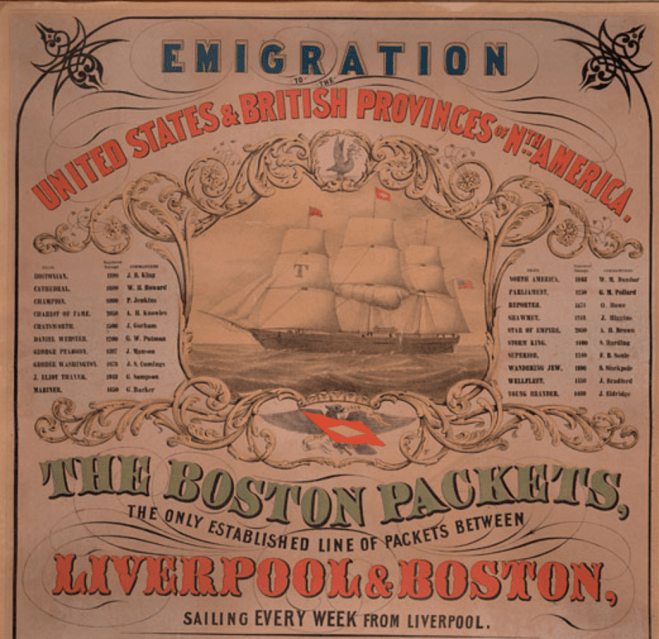
Josiah and I had secured a private cabin aboard a packet ship they called The Shenandoah. For 20 guineas each, we were to be taken to Boston and then onwards by carriage to New York, with three meals a day and the promise of at least one evening in the company of the Captain! I was as giddy as a goat at the sight of my bed for the next five weeks – a doll-sized affair with a ladder, setting me up against the roof of the cabin, with Josiah on a truckle at the base. In truth, Josiah had not shared sleeping quarters with me for many nights of our married life. His frequent trips away, the small bed he has in his study, his capacity for sleeping through his own noisiness, and my wish to be undisturbed until ready, had led to us being sparing in our togetherness. I prefer to share my bed with Dauncey in any case, and would gladly have booked him as my travelling companion, but he is scared of water – poor thing – and would be almost as terrified as me in a new city!

Thus I was to spend my nights with Josiah again; this enforced closeness was unusual, but not altogether unwelcome, I suppose.

I wandered the deck before departure, waving at people gathered on the dockside to see the ship depart – none were there to see Josiah and I safely set sail, of course, but some waved to me nonetheless. There was much cheering and calling out of farewells – it mattered not that none were directly meant for me. I was on an adventure and I fancied myself quite the explorer!

Josiah is a sociable man, as I have recorded in entries past – he set to making himself known amongst our fellow passengers, ensuring that any women travelling alone would know to call on him if they became distressed. His chivalry was unrivalled at that time, and still may be. I do not know. But I must not leap ahead.

I loved my little bunk, with its heavy coverlet and wooden rail – if not for them I might have been tossed out during the dark hours of more than one stormy night, I am certain of it! I marvelled daily at the activities of ship’s crew – whistling to each other from the top of a set of ropes,  heaving heavy wooden objects back and forth, and  endlessly swabbing, clearing and patrolling the decks. I would watch them work for as long as the daylight would allow – stirred by their strength and good cheer.

Save for the sailors, our crossing was both eventful and desperately dull. Hours and hours of slow progress and nothing to see but the horizon – interrupted by  moments of great panic and upheaval. I soon came to realise that the three meals a day were vital, as no-one could be sure to digest any one of them for long.

Josiah did indeed become a place of sanctuary for lone and indisposed  travellers – he was to be found most days holding up some poor woman or other as she grasped the side of the ship in the grip of continual sickness. My stomach for the High Seas was stronger than anyone would have imagined – especially myself I was proud to discover. But my appetite for being with Josiah – for sharing with him the new things I saw and thought –  had certainly waned.

If I am to be honest in these pages (and if not here, then where?)  I was full of hope and anticipation for what I would find in America, but less pleased by what I was bringing with me.

The story of the next 5 years will take 5 minutes to tell. For next time!

Capital Venture

1df2f-journal_smMay 10th 1860, Blindingham Hall

I promised to recount my gains. At such backward looking I see they were not gains at all, but distractions. Nevertheless I shall set them down here. Oh, for a story to tell of happiness! That will be for another time, I hope.

Papa’s passing, shocking and painful though it was, resulted in my being gifted a sum of money which quite put me about. He had made sure to say, in his will and testament, that his bequest should be for me and only me. He declared Josiah to be of independent means and took care to say that he should not receive so much as a guinea from the estate. Bless Papa – he was so proud of Josiah’s nose for commerce, he would not wish to do him the disservice of gifting him unearned wealth.

So, at the age of 27 – childless and without much purpose I would be missed for – I fancied myself quite the traveller. I told Josiah I should like to see what America might offer me. Me! Whose only excursions to date had been down to the village for bread or across a London Square for tea!

Josiah would not countenance my traveling alone – his care for me was boundless, I must attest, and I was pleased he wanted to suspend his business interests in town to spend so much time with me. He promised to use his own money – owing respect to Papa – and told me he had heard of men in New York who would be keen to learn about what London menfolk did to prosper in business. He told me he was determined to become adept in protection – lucky, looked after wife that I was – and would come with me on my adventure. I was more excited than a new rabbit in spring!

We left Villiers to run Blindingham in our absence – his shock at Jennet’s death was a surprise to me but he is a man who feels deeply and I fancy he was glad of the extra responsibility. His concern for the new boy – the simple lad who had been present when Jennet met his end –  had been such that the boy had left his family in the village and moved to lodge in Villiers’ rooms. I will never stop admiring Villiers’ capacity for compassion. He and the boy would make good husbands of the Hall, I was sure.

Within weeks of my decision I had secured passage for Josiah and myself, told Dauncey to behave for his  temporary masters, and filled a trunk with everything I thought I would need for my stay in America.

Learn this from me, if nothing more – preparing for a lengthy stay in another country is a strange and wearisome task.  You will fill your trunk with more, and less, than you need. Without any notion of what the weather or society expects of you, you arrive as a newborn does on its confinement bed, and look to others for help. Further,  you will return with most of what you brought with you, unworn and still folded.

That is of course if you do not depart hastily, as I was forced to do. In such circumstances as I faced, you will say goodbye to clothes and possessions you acquired but which mean little to you.

To return to my story. We embarked for our journey on A bright morning in June 1855. I am too ready for my bed to say more than this tonight. It is enough to say that, on that morning at least, I saw it as an adventure and thus a Gain. The loss came later.


Memento Mori

April 21st 1860, Blindingham Hall

Such flightiness in a grown woman, so unbecoming! No sooner do I take up my pen after 6 years of silence than I set it down again. I fear my first entry after so long was of sufficient darkness to make a person wonder what the intervening years have wrought upon me.

I can scarce bear to recall – but, if my musings to come are to make any sense at all I suppose I must.

In brief, then, prior to my resumption of this journal, these are the events which have brought me to my current state. I fear it is simply a tally of gains and losses, so I will start with the most painful of those.

Papa spent scarce twelve months with us here at Blindingham before contracting a lung condition which took him from us in the space of an afternoon. From the first cry of the Welshwoman to the last gasp in his frail body, I was frozen in fear – my Papa! Dying of a disease which took hold in an instant. He had been enjoying his time here, I fancy, what with his reading and his daily circuits of the grounds. The Welshwoman did indeed take an interest in him and would visit him with things she had baked. I never ate them myself – they seemed to me a love token, for his consumption only. The afternoon he died she had called up to the Hall with a basket of Welsh cakes – I have no notion of what was welsh about them, apart from her having made them – and with only his second or third bite he was overcome with A fit of coughing. I heard her call out for me and as I ran down the lawn to the stone seat he was perched on I saw her beat his back – I am no medic but I do not think that violence towards a man with a sudden onset of infection can be for the good. I asked her to stop hitting him as he was clearly struggling to breathe – poor Papa was red in the face, staring wildly up at her, and me, as I arrived behind her. He reached his hand to me, the one that was not clasped to his throat,  and asked for water. But there was no time – he fell forwards, onto the paving, and fought for breath. A tiny piece of welsh cake appeared on his lips as he passed to the next world (where his spiritual friends were no doubt pleased to see him) – the Welshwoman sobbed and fell to her knees asking for forgiveness, but I like to think his last act was to accept a gift of love and succumb to his infection with dignity. Poor Papa! The doctor from the village, summoned by me and upon hearing my account of events,  declared him dead of an unknown lung affliction. But  I can not to this day look at baked goods without a rising in my throat – such a kind man, snatched too soon.


And Jennet. Poor Jennet, who was never happily married to that stupid girl but was married to her all the same. He took delivery of a new machine designed to make cutting the grass less arduous. As Head Gardener he was always abreast of new methods in the gardening world. He was teaching his new boy – a booby whose only chance of work was outdoors amongst nature – how to handle this machine on a quiet afternoon on the top lawn when it malfunctioned in some fashion. According to Villiers, who was watching this lesson with great interest, the boy pulled a lever which set some mechanism in motion.  Jennet shouted ‘Not yet, Boy, not yet, take it slowly!’ Which made the boy laugh for some reason – the machine took flight, Jennet leaped to control it and it fell on him. He lay under it, I was told, for an hour or so waiting for the boy to fetch help. But some form of grinding mechanism was still activated and Jennet became embedded in its grip. He died in agony, I gather, but in the pursuit of his beloved profession. Poetic, but also bizarre.

There were other losses, but of no-one consequential. Villiers saw off that fool Garforth – not to his death, I must point out, but to a luckless household in Bideford.

I make mention of Villiers and what do I hear? He is even now warming the water for my bath. I shall speak of the gains another time, when I have fully grasped what they were.


Ringside Seat

Screenshot 2020-06-25 12.54.09

April 15th  1860

It has been an absolute age since I last committed my thoughts to paper! There is much to say and much that has been forgotten, but the call to set down my thoughts once more has been strong, of late.

I must confess that it was the sight of the newly widowed Mrs Cornbench – alone and seated shrunkenly at the service this past Sunday – that has brought me to a sensation  I feel I must lay down here, in private, where no one will censure my thoughts.

I envy her.

She sat without her husband, whose burial mound is still not sunken, and without her children. I do not know where they were – I trust being cared for by another until she is able to return to them – but as I watched her sit there, unburdened and untouched, I wished that she were me.

She held her hands in her lap, her wedding band clearly loose on her finger. Loose, worn-down and dull as a mid-March morning. As I stared, I felt my own band pinching the skin on my left hand, causing my finger to swell slightly and wish me to be rid of it.

Oh, how wicked this thought is!

I feel the constraints of my wedding ring as keenly as I do my marriage. God strike me, I wish Josiah were as liable to imminent loss as Mrs Cornbench’s ring. To slide noiselessy from sight and touch, its absence more likely to be noted by observers, than by her or me.